With the transformation of the global energy structure to clean and low-carbon, the new energy industry is developing at an unprecedented speed. Key fields such as lithium-ion batteries, hydrogen fuel cells, and photovoltaic modules have put forward extremely high requirements for the precision processing of materials. In this context, slitting and rewinding machines, which are traditionally widely used in papermaking, film and other industries, are quietly becoming indispensable "invisible craftsmen" in the manufacturing of new energy materials through technological innovation and intelligent transformation.
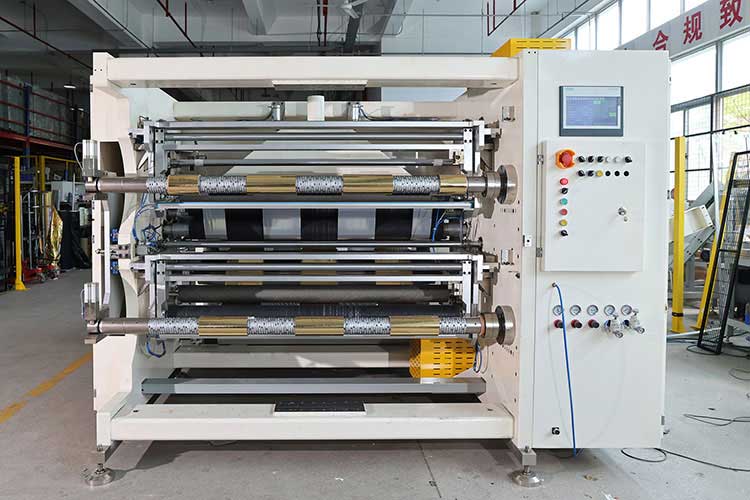
From tradition to innovation: technological upgrades meet demanding demands
Traditional slitting and rewinding machines mainly realize the functions of longitudinal slitting, rewinding and winding of materials. However, in the field of new energy, it is no longer faced with ordinary paper or plastic film, but with extremely thin, brittle or functional materials with special coatings, such as:
• Battery separator (up to 5 microns thick)
• Electrode current collector (copper foil, aluminum foil, thickness 6-12 microns)
• Photovoltaic backsheet film (multi-layer composite structure)
• Fuel cell proton exchange membrane (moisture sensitive)
These materials have extremely demanding requirements for slitting quality, tension control, cleanliness and efficiency. To this end, the new generation of slitting and rewinding machines has achieved breakthrough innovations in several dimensions:
1. Ultra-precision tension control and correction system
The use of multi-stage independent closed-loop tension control and high-precision visual correction technology ensures that the tension fluctuation is controlled within ±0.5% when slitting ultra-thin and wrinkled materials, avoiding material stretching, wrinkling or fracture caused by uneven tension, and greatly improving the winding quality and yield.
2. Laser and ultrasonic slitting technology
In response to the problem that traditional blade slitting is prone to burrs, dust, and heat-affected zones, laser slitting technology achieves contact-free and high-precision "cold processing", especially suitable for brittle coating materials and ultra-thin metal foils. Ultrasonic slitting achieves clean cutting through high-frequency vibration, significantly reducing dust pollution, which is crucial for the production of battery electrodes with extremely high cleanliness requirements.
3. Intelligent defect detection and big data analysis
Integrated online inspection systems (such as CCD vision, infrared scanning) monitor defects such as pinholes, scratches, and uneven coatings on the surface of materials in real time, and link them with production data. Through machine learning algorithms, the system can predict tool wear and equipment anomalies, realizing the transformation from "post-detection" to "pre-prevention".
4. Fully closed-loop clean room adaptation design
For materials with "zero tolerance" to dust such as battery separators, the new generation of equipment adopts a fully sealed structure, local micro-positive pressure design, and is equipped with an ionic air cleaning device, which can be directly installed in a clean room of 10,000 or even 1,000 levels to avoid secondary pollution.
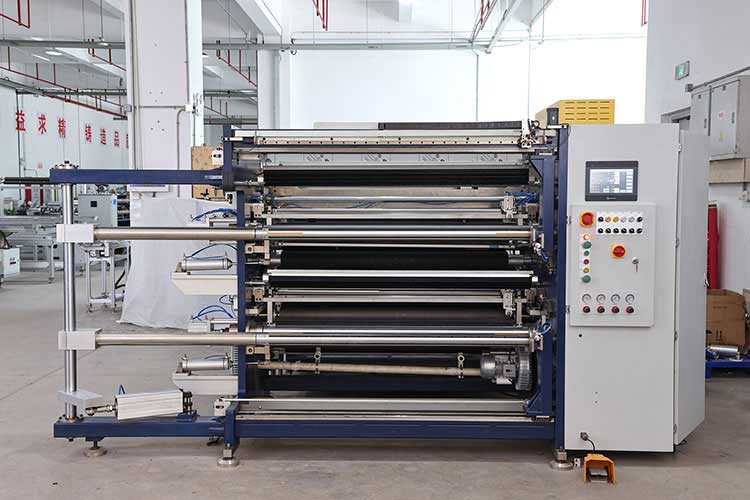
Innovative application scenarios: drive new energy manufacturing to improve quality and efficiency
In the lithium battery industry chain, the slitting and rewinding machine is the core equipment for electrode manufacturing (after coating) and separator production. For example, when slitting and coating electrodes, the innovative application of "intermittent winding" and "online mass sorting" technologies can automatically remove defective fragments without stopping the machine, and non-destructively bond good products, increasing production efficiency by up to 30%. For the diaphragm, the "micro-tension" and "edge reinforcement winding" technologies are used to effectively solve the problem of curling caused by the inconsistent shrinkage rate of the wet diaphragm.
In the photovoltaic field, when used for slitting photovoltaic backsheet films (such as TPT and KPK structures), the relative slippage caused by different elastic modulus of each layer is avoided through the synchronous slitting and tension control of multi-layer materials, and the integrity of the composite structure is ensured. At the same time, for the increasingly popular flexible photovoltaic modules, a slitting process suitable for ultra-thin polymer substrates has been developed, with a minimum slitting width of up to 0.5mm, which provides the possibility for the manufacture of micro-photovoltaic arrays.
In the field of hydrogen fuel cells, proton exchange membranes (PEMs) are extremely sensitive to humidity and temperature. The dedicated slitting rewinder completes all operations in a constant temperature and humidity chamber, and uses non-contact transmission and static elimination technology to ensure the chemical stability and physical integrity of the membrane electrode core material during the slitting process.
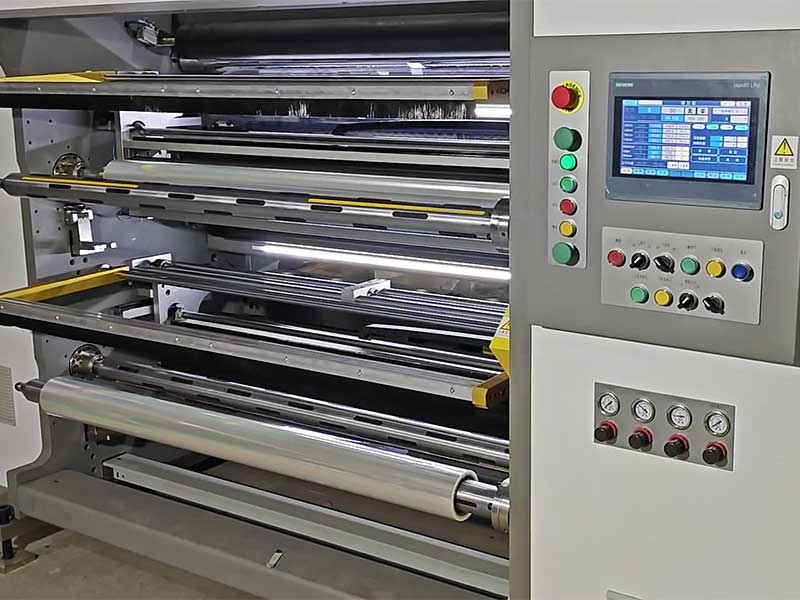
Future trend: intelligence and integrated integration
In the future, the innovation of slitting and rewinding machines will focus more on "intelligent manufacturing" and "production line integration":
• Digital twin and adaptive control: By building a digital twin model of the equipment, the slitting parameters are simulated and optimized in real time, and the process parameters under different material formulations are automatically matched.
• Deep integration with the front and back processes: The slitting and rewinding machine will no longer be an independent unit, but will be seamlessly linked to coating, die-cutting, lamination and other processes, forming a "black light" production line for continuous production. For example, in battery manufacturing, direct linkage from pole slitting to cell lamination can be realized to reduce transit and damage.
• Green and energy-saving design: adopt an energy recovery system to feed braking energy back into the grid; Develop a clean cutting process that is waterless and free of chemical solvents, reducing the overall carbon footprint.
• Forward-looking layout for new materials: As new technologies such as solid-state batteries and perovskite photovoltaics mature, equipment manufacturers are developing ultra-precision slitting solutions suitable for brittle, thinner or flexible stretchable new materials in advance.
epilogue
In the journey of new energy material manufacturing towards high-end and precision, the slitting and rewinding machine has evolved from a simple "cutting tool" to a key process equipment integrating precision machinery, intelligent control and online testing. Its continuous innovation not only directly improves material utilization, production efficiency and product consistency, but also lays a solid foundation for the performance improvement and cost reduction of downstream cells and photovoltaic modules. As one industry expert put it: "In the world of new energy, every micron of precision can mean a percentage increase in energy density. The slitting rewinder, an unknown "invisible craftsman", is cutting a new picture of the new energy era with its evolving skills.
 English
 Deutsch
 Français
 Español
 Português
 日本語
日本語 русский
 한국어
한국어 عربي
عربي ภาษาไทย
 Tiếng Việt
 Italiano
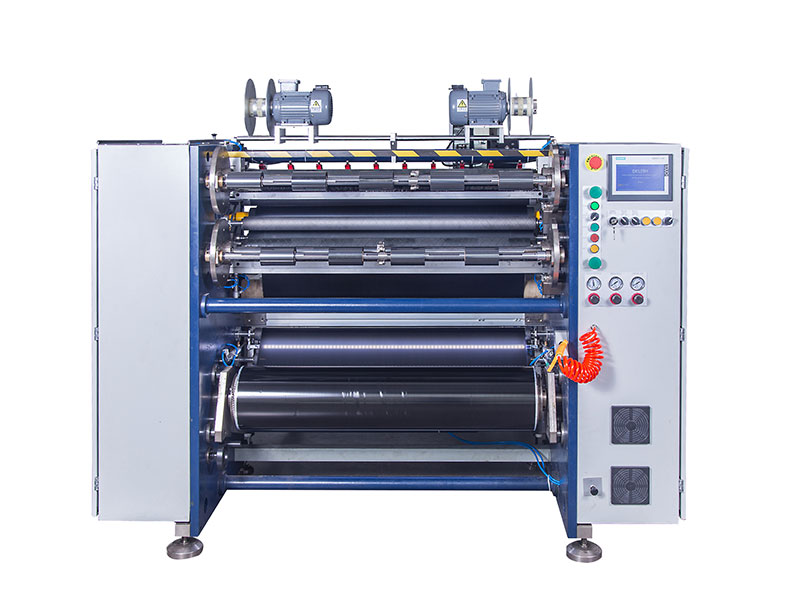
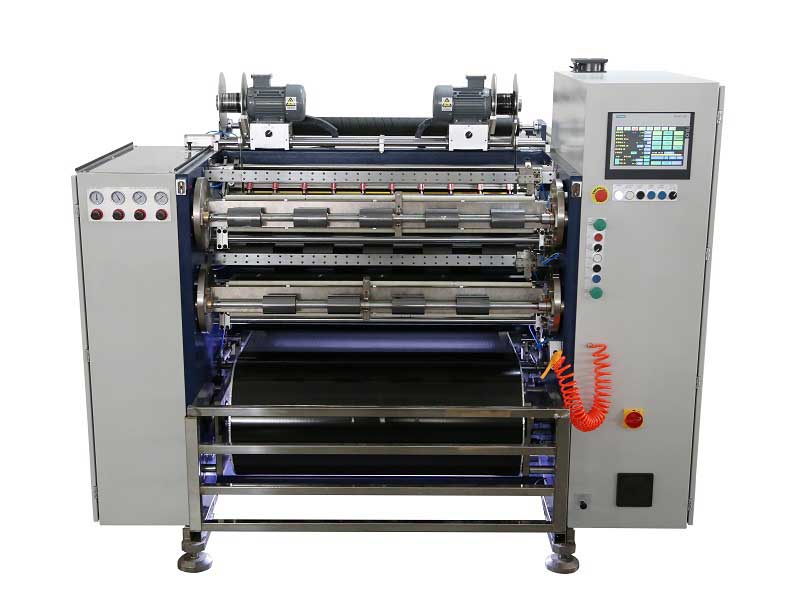 Automatic Thermal Transfer Ribbon Slitting Machine RSDS8 H PLUS
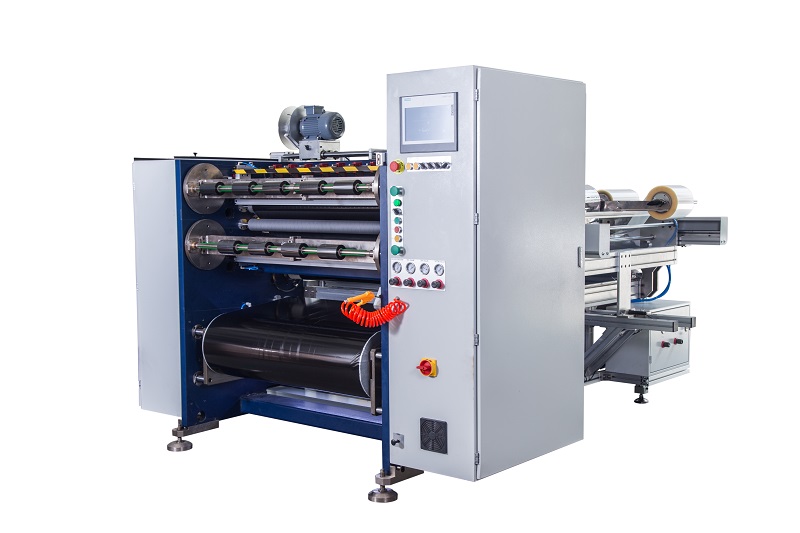 Semi Automatic Thermal Transfer Ribbon Slitting Machine RSDS5 PLUS
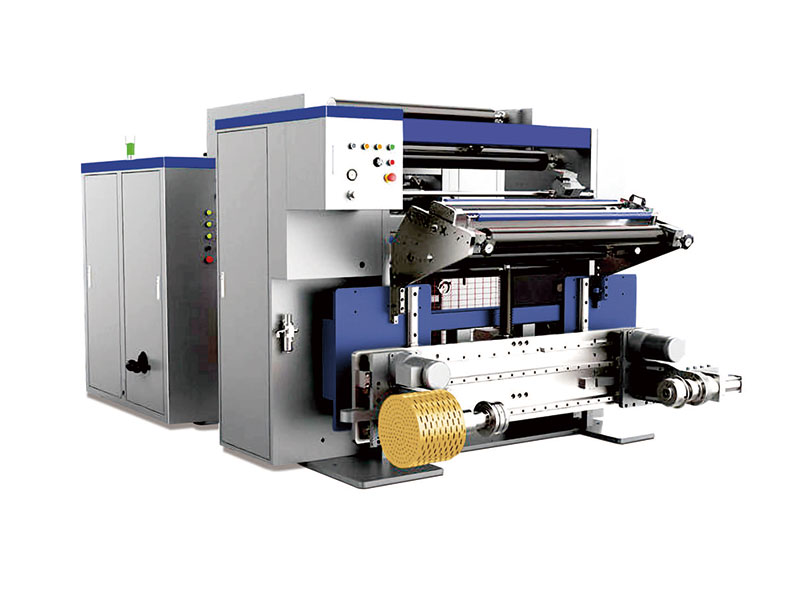 High Speed Slitting Machine
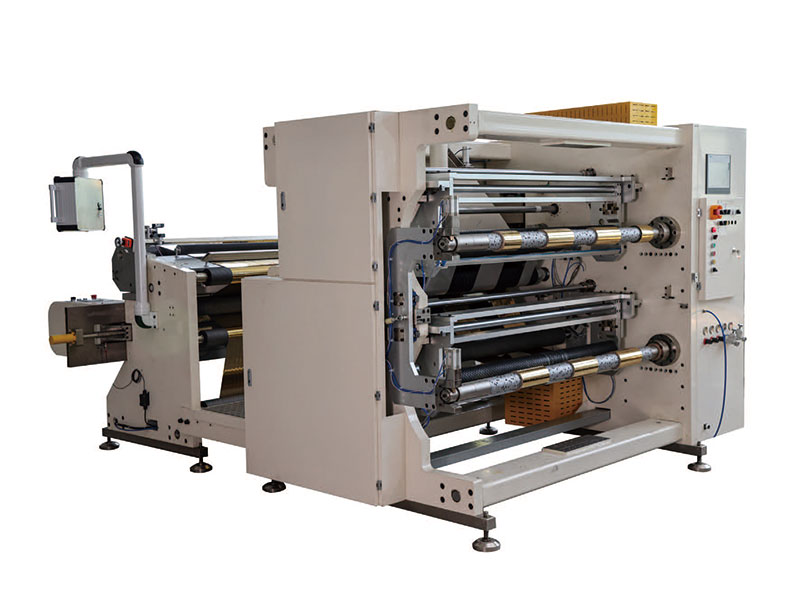 1400mm Hot Stamping Foil Slitting Machine
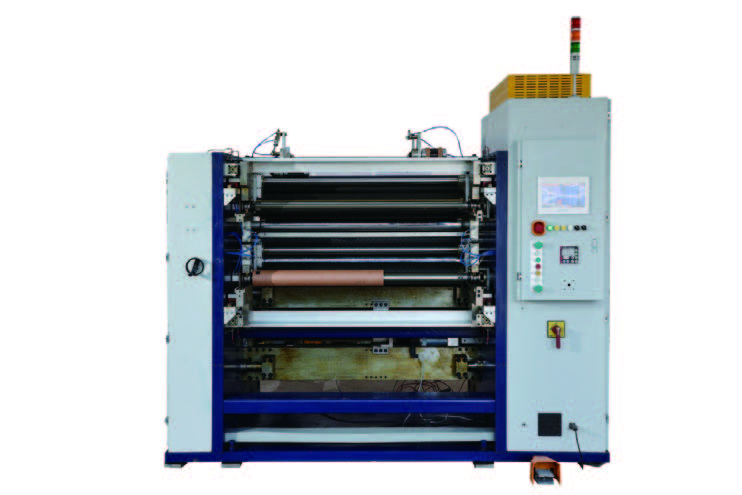 New Energy Ultra-thin Film Slitting Machine For Capacitive Film
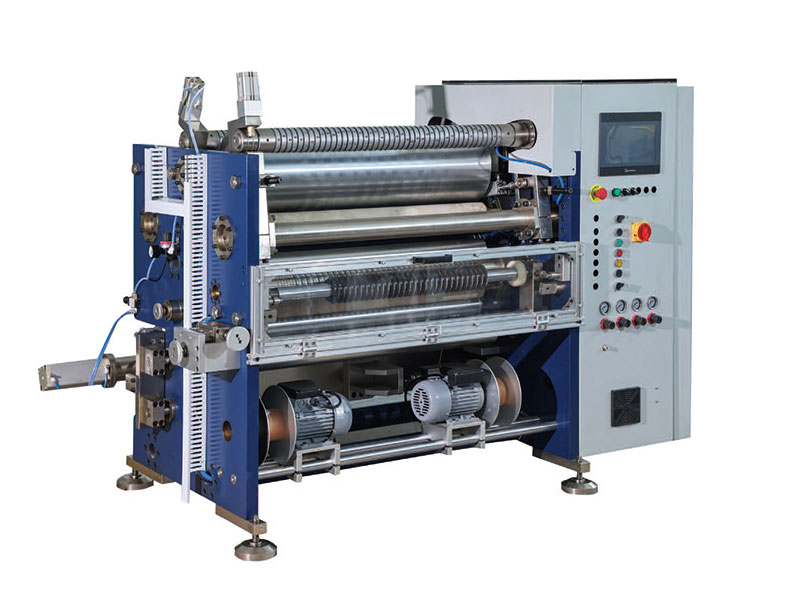 800mm Hot Stamping Foil Slitting Machine
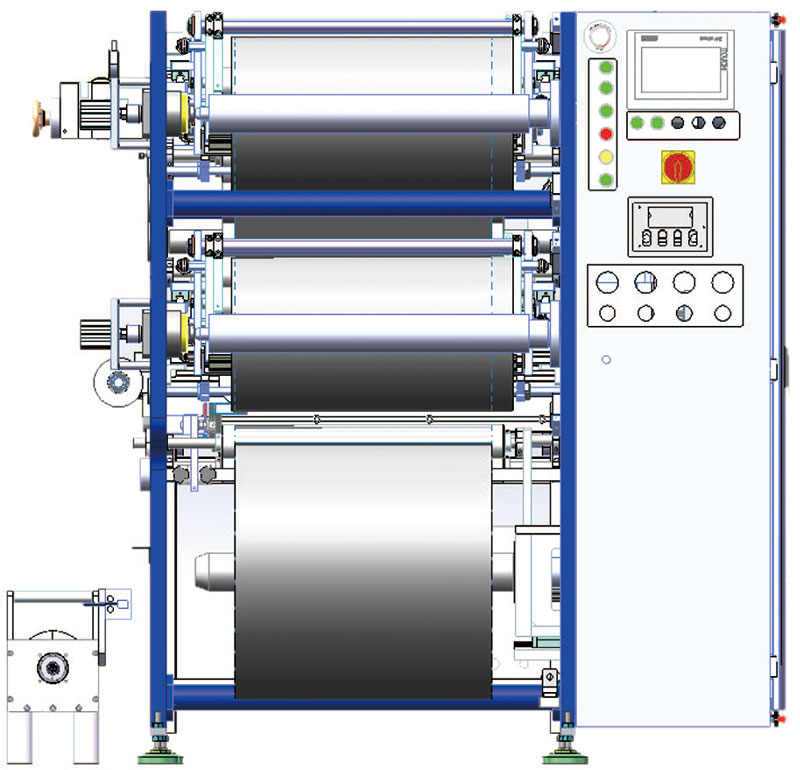 Customerized Slitter
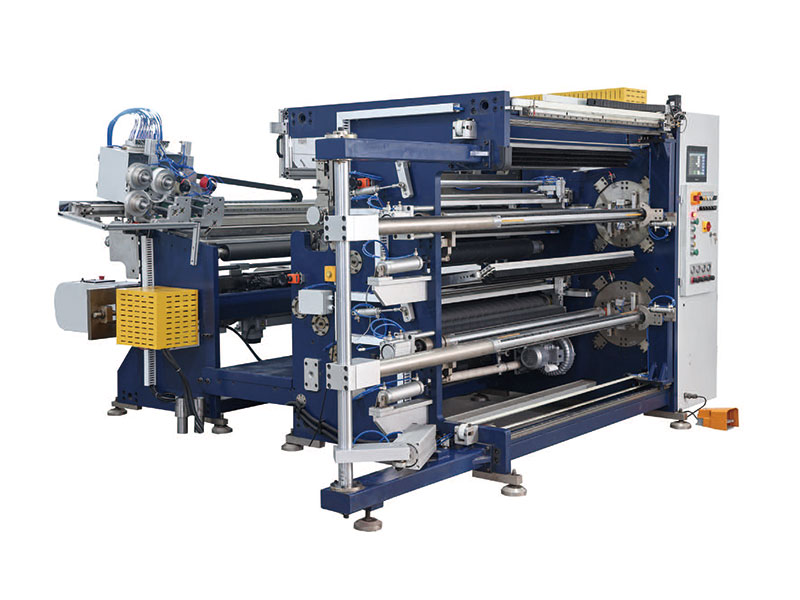 1350mm Hot Stamping Foil Slitting Machine


 +86 135 9951 7291
 support@delishmachine.com